
A commercial snow contract should specify six things in writing: the trigger depth, the pricing model, how salt and ice are handled and billed, how fast the crew must respond, a site map showing where snow goes and what is hidden under it, and the insurance and records that stand behind the work. If any of those is left to "we'll handle it," that is the clause you will be arguing about in February.
Contracts for this winter are being signed now. This is the checklist we would want a property or facility manager to hold any proposal against, including ours.
What trigger depth should the contract use?
The trigger is the snow depth at which the contractor mobilizes without being called. Most Greater Boston commercial contracts use two or three inches. Two inches suits retail, medical offices, anything that opens early, and any site with steady foot traffic. Three inches can work for a site closed overnight that can wait for a single clean pass.
Two things around the number matter more. First, how depth is measured: on site, at a named weather station, or by the contractor's judgment. Write it down. Second, what happens below the trigger. The storm that causes claims in Massachusetts is rarely the foot of snow. It is the inch and a half at 33°F that turns to rain, then drops to the low 20s overnight. If the contract says nothing happens under two inches, nothing will, and the lot will be glass at 6am.
Per-push, per-event or seasonal?
- Seasonal: one fixed price for the winter, regardless of snowfall. You are buying a number you can put in a budget. In a heavy year you come out ahead; in a light one you have paid for coverage you did not use.
- Per-push: a price each time the lot is plowed. Cheap in a mild winter, expensive and hard to forecast in a snowy one. Watch how a "push" is defined, because a long storm can be several of them.
- Per-event: a price per storm, often banded by total accumulation. Closer to the real cost of a storm, but the bands and the definition of when one event ends and the next begins need to be explicit.
Properties that answer to an annual budget usually choose seasonal. Whatever the model, look for the exceptional-storm clause: some contracts cap the events or inches covered, or bill hauling separately once storage areas are full. Neither is unreasonable. Finding out in March is.
How should salt and ice management be written?
Plowing moves snow. Ice management is what keeps the site usable afterwards, and it is where most contract disputes start. The contract should say:
- Whether materials are included in the price or billed per application, and at what rate
- Which surfaces get treated: drive lanes, parking stalls, sidewalks, entrances, stairs, ramps
- Whether pre-treatment is part of the service and who decides when it is used
- What triggers a return visit for refreeze, with no new snow falling
- What material is used near plantings, pavers and new concrete
Massachusetts winters swing across the freeze line constantly, which is why pre-treatment earns its place. Brine applied before a storm stops snow and ice bonding to the pavement, so the plow scrapes clean instead of packing a layer down. Rock salt also loses most of its effect below roughly 15°F, so a contract should allow for a different material on the coldest nights rather than more of the same salt.
What response window is reasonable?
Ask for two numbers: how soon after the trigger the crew arrives, and how soon the site is open. Define "open": drive lanes passable, or every stall, walk and entrance cleared. Match both to the site's real deadlines, and to your town's deadline for clearing sidewalks after a storm.
Then ask about capacity: how many sites are on that route, and how long the loop takes in a long storm. A contractor with more properties than they can clear inside a storm window misses all of them at once. Casa Blanca Services, Inc. caps its seasonal book for exactly that reason.
Why does the contract need a site map?
Six inches of snow hides curbs, islands, fire hydrants, catch basins, speed bumps, low walls and the edge of every landscaped bed. A site map, agreed before the first storm, should mark:
- Where snow is stacked, and where it must never go
- Fire lanes, hydrants and accessible parking spaces and routes that must stay clear
- Catch basins and the path meltwater takes, so piles do not refreeze across a walkway
- Obstacles that need staking: curbs, islands, bollards, walls
- Dumpster pads, loading docks and any area with its own timing
A pile placed uphill of a walkway melts every sunny afternoon and refreezes across it every night. We walk the property, mark obstacles and drainage, and agree stacking areas before the snow arrives.
What liability and insurance terms matter?
Since the Supreme Judicial Court's 2010 decision in Papadopoulos v. Target Corp., Massachusetts property owners owe lawful visitors reasonable care for snow and ice, as they do for any other hazard. A contract cannot hand that duty to someone else, but it does decide what stands behind the work. Ask for:
- A current certificate of insurance before the season starts, with coverage limits stated
- Whether the property owner and manager will be named as additional insureds
- Indemnification language that both sides have actually read, ideally reviewed by counsel
- A time-stamped log of every visit: time on, time off, services performed, materials applied
The log is the one most often skipped and most often needed. A claim can arrive more than a year later, and "we always plow at two inches" is not evidence. A time-stamped record is. Casa Blanca Services, Inc. logs every visit for that reason, and is licensed and insured, with certificates on file before the season starts. We are also a SIMA member, the Snow & Ice Management Association.
Questions to ask before you sign
- Is the equipment owned, or rented once the season starts?
- Is salt stored under cover and stocked before the first storm?
- What happens when a truck breaks down mid-storm?
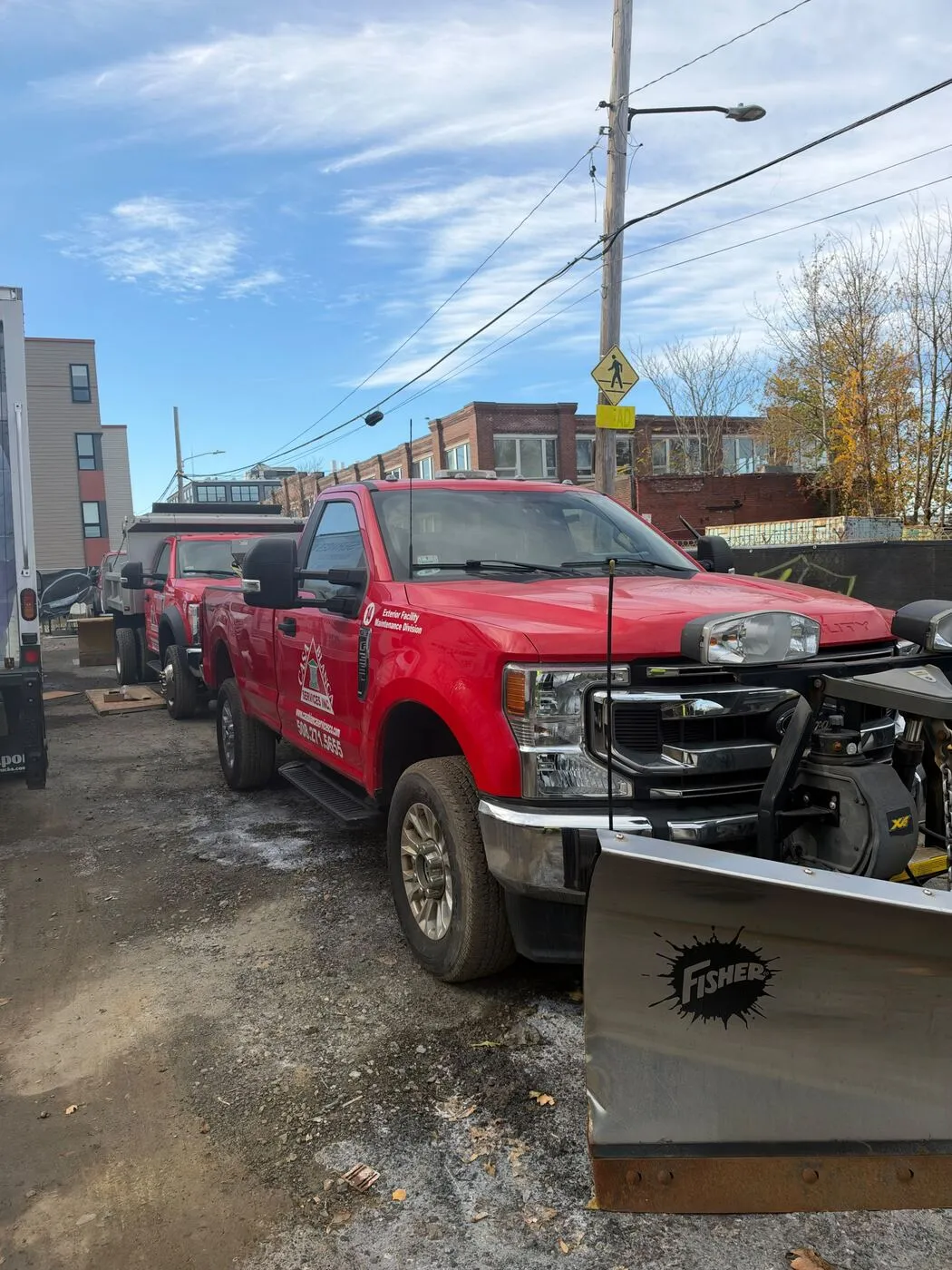
Winter capacity is decided by what is in the yard before the first storm. Ours is on the equipment page: a rack of Boss plows, plow-equipped Ford Super Duty pickups, an International dump truck with its own plow, loaders for stacking, a brine tank and walk-behind spreaders, and covered salt storage on site.
Casa Blanca Services, Inc. works commercial lots, condominium and HOA properties, apartment buildings and private roadways across Greater Boston on seasonal and per-event contracts. If you are comparing proposals for this winter, our commercial snow and ice management page explains how we set a site up, or call and we will walk the property with you.
Common Questions
What trigger depth should a commercial snow contract use?
Most commercial contracts in Greater Boston use a two-inch or three-inch trigger. Retail, medical and anything open early with public foot traffic usually wants two inches or less. A site that is closed overnight can sometimes live with three. Whatever the number, the contract should also say what happens below the trigger, because a one-inch event followed by a hard freeze is where slip-and-fall claims come from.
Is a seasonal snow contract cheaper than per-push?
In a heavy winter, usually yes; in a light one, no. Seasonal buys a fixed, budgetable number. Per-push tracks the actual winter but makes the budget unpredictable. Many contracts combine the two: seasonal plowing with materials billed per application.
Who is liable if someone slips on a plowed lot in Massachusetts?
The property owner owes lawful visitors reasonable care for snow and ice, a duty the contract cannot transfer. The contract decides what the contractor is responsible for, the insurance behind it and the records that exist. This is general information, not legal advice; have counsel review the indemnification terms.
When should a commercial snow contract be signed?
Before the first plowable storm, ideally in October or early November. Contractors who cap their seasonal book fill it in the autumn, and a site added in December goes on whatever route still has room.
Written by Yacine Ibrahimi, Founder & CEO of Casablanca Services, Inc.. Casablanca Services has worked in Greater Boston since 2005 and is listed by the City of Boston as a local mattress recycler. Questions? Call (508) 271-5655.